
You’re standing at a fork in the road that will shape how your product tastes, what it costs to make, where you can legally sell it, and whether your customers trust the label. Terpene sourcing is one of those decisions that feels small on a spec sheet and turns out to be enormous in practice.
Most brand founders reduce it to a two-way choice: cheap botanical terpenes or premium cannabis-derived terpenes. That framing is incomplete. There’s a third path that has quietly changed what “authentic” can mean, and it’s worth understanding all three before you commit a formulation, a budget, or a brand promise to any of them.
Here’s the honest breakdown of botanical terpenes, cannabis-derived terpenes, and True To Plant, and how to figure out which one actually fits what you’re building.
What are botanical terpenes?
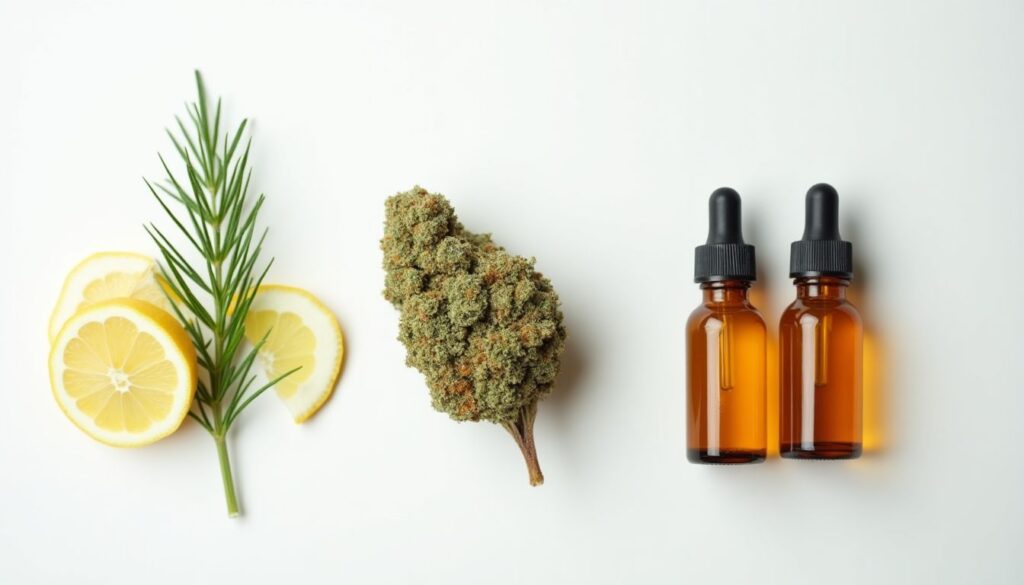
Botanical terpenes are aroma compounds extracted or synthesized from non-cannabis sources like citrus, pine, hops, lavender, and other plants that happen to produce the same molecules found in cannabis. Limonene from an orange peel is chemically identical to limonene from a cannabis flower. The molecule doesn’t know where it came from.
Formulators buy these individual isolates and blend them to approximate the terpene profile of a known strain. Want something that reads as “Blue Dream”? You mix myrcene, pinene, caryophyllene, and a handful of others in ratios meant to mimic the real thing.
The appeal is straightforward. Botanical terpenes are typically the cheapest option, often in the range of a few dollars to low tens of dollars per gram depending on complexity and volume. They’re widely available, shelf-stable, and easy to source at scale.
The catch is authenticity. A botanical blend is an interpretation, not a copy. It can smell great and perform well, but it’s an approximation of a cultivar rather than a faithful reproduction of one. For a lot of products, that’s completely fine. For premium positioning that leans on strain fidelity, it can fall short.
What are cannabis-derived terpenes (CDT)?
Cannabis-derived terpenes are extracted directly from the cannabis plant, usually as a byproduct or co-product of extraction, and captured through methods like steam distillation, fractional distillation, or cold separation from live or fresh-frozen material.
Because they come from the actual plant, CDT carry the full, messy complexity of the source flower. That includes trace compounds that never make it into a botanical blend, which is often why people describe CDT products as tasting “truer” or more complete.
That authenticity comes at a price. Cannabis-derived terpenes are typically the most expensive of the three, often ranging from tens to well over a hundred dollars per gram, because yields are low and the input material is valuable in its own right. Extracting terpenes competes with extracting cannabinoids for that same biomass.
There’s also the batch-variability problem. Real plants differ from harvest to harvest, so two batches of the “same” strain CDT won’t be identical. That variation is part of the charm for some buyers and a formulation headache for others who need consistency. If a live, plant-sourced character is what your product needs, options like Entour’s live-derived terpene blends sit in this category.
What is True To Plant?
True To Plant is a method that recreates the exact chemical fingerprint of a specific cultivar using detailed GC-MS analytical data and precision blending, rather than extracting from the plant or loosely approximating a profile.
The process starts with characterizing real cultivars. GC-MS (gas chromatography-mass spectrometry) measures the terpene composition of a genuine flower down to precise ratios. That analytical fingerprint becomes the target. Formulators then blend high-purity terpene isolates to match that fingerprint faithfully, cultivar by cultivar.
The result sits in an interesting middle ground. You get the fidelity people want from cannabis-derived material, because the target is a real, verified cultivar profile, without inheriting all of the sourcing and batch-consistency constraints that come with extracting from cannabis biomass every single time.
It’s not a botanical blend guessing at a vibe, and it’s not a plant extraction locked to a harvest. It’s a data-driven reproduction of a documented cultivar. Entour’s cultivar-authentic native blends are built on this approach, drawing on a library of GC-MS cultivar profiles to reproduce specific strains consistently.
How the three compare on cost, legality, and consistency
The differences are easier to see side by side. These figures are approximate and move with volume, complexity, and market conditions, so treat them as directional rather than fixed quotes.
| Factor | Botanical | Cannabis-Derived (CDT) | True To Plant |
|---|---|---|---|
| Relative cost | Lowest (typically a few to low tens of $ per gram) | Highest (often tens to $100+ per gram) | Middle (premium over botanical, usually below CDT) |
| Authenticity | Approximation of a profile | Direct from the plant, fully complex | Faithful reproduction of a verified cultivar fingerprint |
| Legality | Broadly legal as flavoring ingredients | Restricted to legal-cannabis states; extraction is federally Schedule I | Generally follows botanical-ingredient status, no cannabis extraction required |
| Consistency | High, batch to batch | Variable, tied to harvest | High, matched to a fixed analytical target |
| Best for | Cost-sensitive, high-volume, flavor-forward products | Premium plant-authentic products in legal states | Strain-faithful products that need scale and consistency |
The legality question you can’t skip
Legality is where a lot of founders get surprised, so it deserves its own moment. The three options do not share the same regulatory footing, and that difference can dictate your entire go-to-market.
Botanical terpenes are generally legal as flavoring and fragrance ingredients because they’re sourced from common plants with no connection to cannabis. That’s why they can ship across state lines and appear in products almost anywhere. They live in the same broad category as other food and cosmetic aroma compounds.
Cannabis-derived terpenes are a different story. Because they’re extracted from the cannabis plant, they’re tied to cannabis regulation. In practice that means CDT are typically restricted to legal-cannabis markets, and cannabis extraction remains federally Schedule I. Sourcing, transporting, and using true CDT has to respect those boundaries.
True To Plant blends are built from botanical-grade isolates matched to cultivar data, so they generally follow the more permissive botanical-ingredient pathway. You get cultivar fidelity without needing to extract from cannabis. Always confirm current federal and state rules for your specific product and market before you finalize anything, because this area shifts and the details matter.
What consumers actually perceive
Perception and chemistry aren’t the same thing, and pretending otherwise will cost you. A meaningful slice of the market believes cannabis-derived terpenes are inherently superior, full stop. That belief drives real purchasing behavior even when a blind taste test might complicate the story.
“Cannabis-derived” carries weight on a label. It signals plant-true, premium, and closer to the flower. If your audience is educated and specifically shopping for that origin story, botanical blends can read as a shortcut no matter how well they perform.
True To Plant sits in a more nuanced spot. It won’t claim to be extracted from cannabis, because it isn’t, but it can honestly claim to reproduce a specific real cultivar’s profile with analytical precision. For brands that want authenticity messaging they can actually stand behind, that’s a strong and defensible position.
The mistake to avoid is overclaiming. Calling a botanical blend “cannabis-derived” isn’t just misleading, it’s the kind of thing that erodes trust the moment a knowledgeable customer catches it.
Which one should your brand choose?
There’s no universally correct answer, only the right fit for your positioning, margins, and market. Run your situation through this quick logic.
- Choose botanical if you’re cost-sensitive, selling at volume, competing on price or accessibility, and flavor performance matters more than strain-origin storytelling. It’s legal almost everywhere and consistent batch to batch.
- Choose cannabis-derived if you’re building a premium, plant-authentic product inside legal-cannabis markets, your customers specifically want extracted-from-flower origin, and you can absorb both the higher cost and the batch variability.
- Choose True To Plant if you want genuine cultivar fidelity plus the consistency and broader legality that come from not extracting cannabis. It fits brands that need real strain accuracy at scale without being locked to legal-state-only distribution.
Plenty of brands end up running more than one. A founder might use botanical blends for a value line, reserve CDT for a flagship product in legal states, and rely on True To Plant for a nationally distributed premium range that still needs to taste like specific cultivars. Sourcing strategy doesn’t have to be monogamous.
The role of formulation quality
Whichever route you pick, execution separates a good product from a forgettable one. A True To Plant blend is only as trustworthy as the cultivar library and the analytics behind it, and a CDT product is only as good as its extraction and handling.
This is where working with a formulation partner earns its keep. Entour, led by Dr. Jeffrey Raber, pairs a hybrid ecommerce and B2B custom-formulation model with a library of 150+ cultivar profiles, GC-MS characterization, and cGMP manufacturing. That combination of analytical depth and production discipline is what lets a cultivar-authentic promise hold up in the real world.
Ask hard questions of any supplier. How are cultivars characterized? What’s the batch-to-batch tolerance? Can they show the analytical data behind a profile? The answers tell you whether “authentic” is a marketing word or a measurable standard.
Making the call
Botanical, cannabis-derived, and True To Plant aren’t better or worse in the abstract. They’re tools, each suited to a different combination of budget, distribution footprint, and brand story.
Botanical wins on cost and reach. CDT wins on plant-true authenticity where the law allows it. True To Plant threads the needle, offering documented cultivar fidelity with the consistency and legality that let a brand scale. Match the tool to the job you’re actually trying to do.
If you’re weighing where your next formulation should land, it helps to see the options side by side. Explore Entour’s True To Plant cultivar blends and its live-derived options, then bring your positioning and volume goals to the table so the sourcing decision serves the brand you’re building, not the other way around.